Aggregate research dataset
SeasonKeep Home Maintenance Rules Study
An aggregate analysis of 227 home maintenance rules across 18 systems. The dataset documents how the catalog is classified and scheduled; it does not describe homeowner behavior or a typical household's task list.
- Version
- 2026-08-11
- Catalog snapshot
- 2026-08-11
- Published
- Last updated
- Publisher
- Edison Forge, LLC
- License
- CC BY 4.0
Snapshot findings
What the catalog contains
Each count comes from the complete rule catalog at the snapshot date. A rule can appear in more than one monthly assignment.
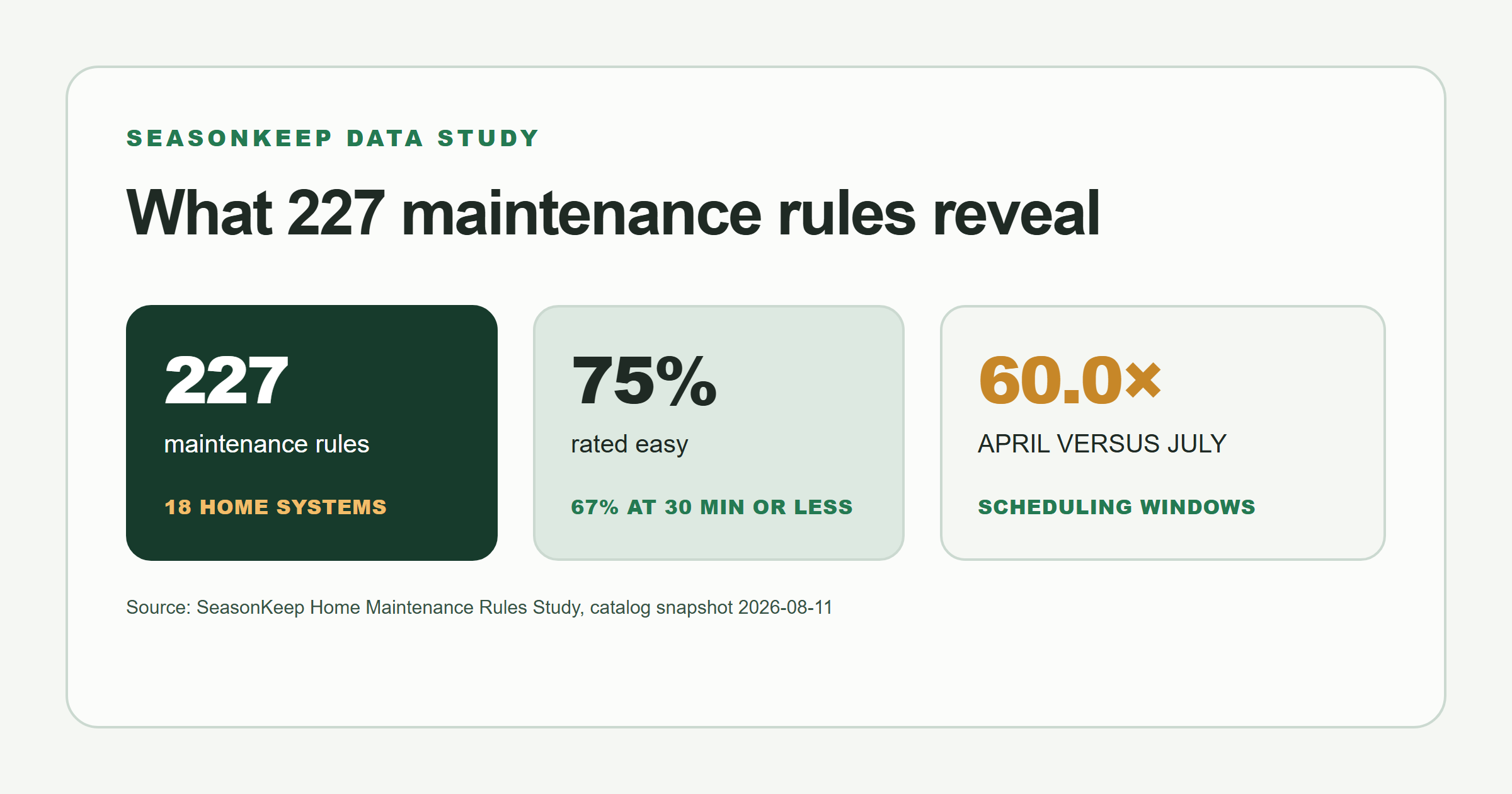
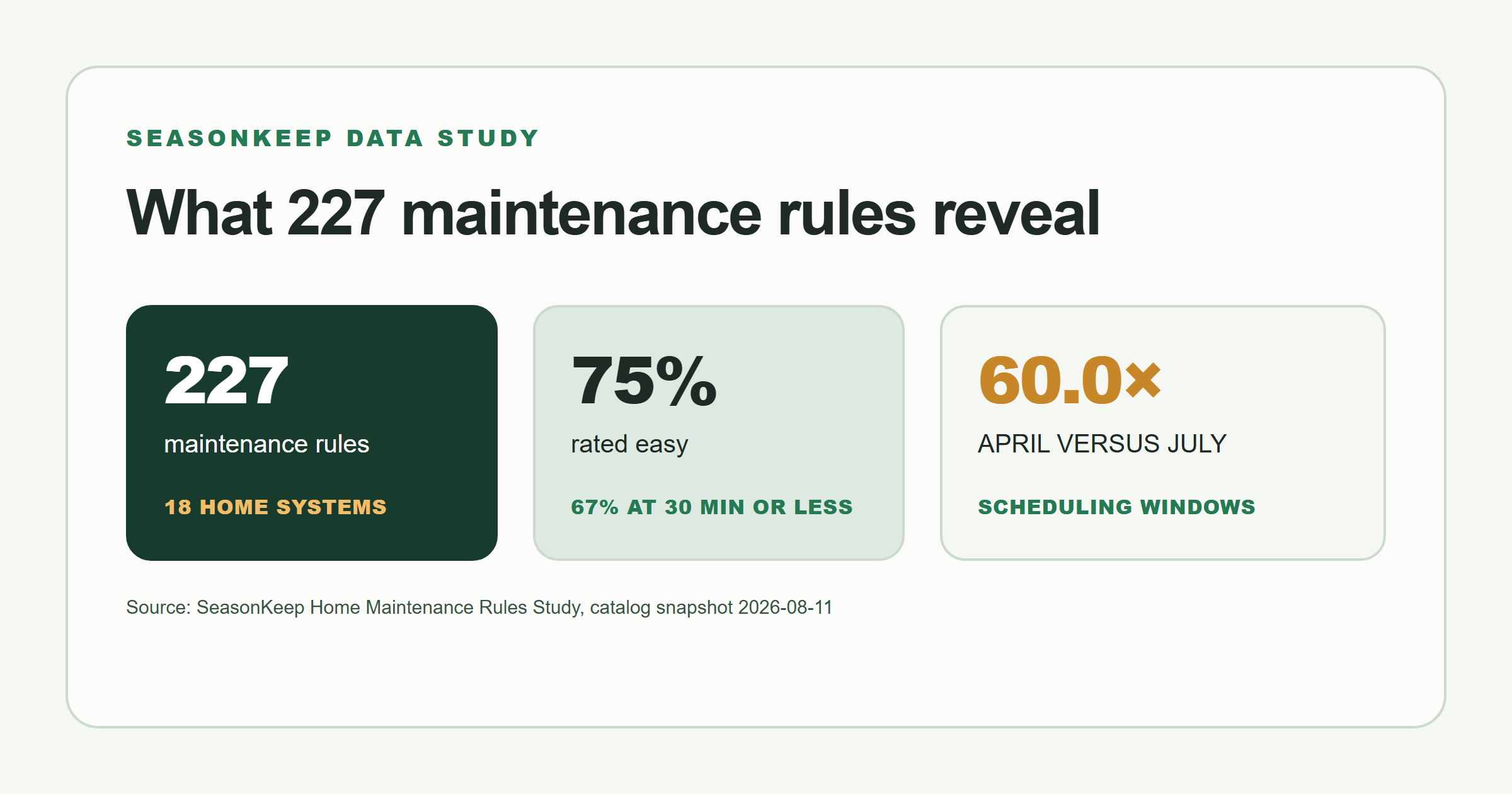
227
rules in the snapshot
75%
classified as easy
67%
with an active-work midpoint at 30 minutes or less
60×
April versus July assignments
| Classification | Rules | Share |
|---|---|---|
| Easy | 170 | 74.9% |
| Moderate | 26 | 11.5% |
| Professional only | 31 | 13.7% |
| Classification | Rules | Share |
|---|---|---|
| Critical | 23 | 10.1% |
| High | 77 | 33.9% |
| Medium | 104 | 45.8% |
| Low | 23 | 10.1% |
| Month | Rules | Share |
|---|---|---|
| January | 9 | 4.0% |
| February | 12 | 5.3% |
| March | 53 | 23.3% |
| April | 120 | 52.9% |
| May | 62 | 27.3% |
| June | 9 | 4.0% |
| July | 2 | 0.9% |
| August | 8 | 3.5% |
| September | 66 | 29.1% |
| October | 90 | 39.6% |
| November | 14 | 6.2% |
| December | 7 | 3.1% |
| Classification | Rules | Share |
|---|---|---|
| HVAC | 30 | 13.2% |
| Exterior | 23 | 10.1% |
| Plumbing | 23 | 10.1% |
| Roof | 22 | 9.7% |
| Landscaping | 21 | 9.3% |
| Electrical | 16 | 7.0% |
| Appliances | 13 | 5.7% |
| Pest Control | 12 | 5.3% |
| Safety | 12 | 5.3% |
| Interior | 9 | 4.0% |
| Foundation | 8 | 3.5% |
| Solar | 8 | 3.5% |
| Water Heater | 8 | 3.5% |
| Pool | 7 | 3.1% |
| Garage | 5 | 2.2% |
| Generator | 5 | 2.2% |
| Hot Tub | 4 | 1.8% |
| Fireplace | 1 | 0.4% |
Time, cost, season, and climate measures
- Active-work midpoint at or below 30 minutes
- 153 (67.4%)
- 227 catalog rules
- Rules with DIY and professional cost ranges
- 13 (5.7%)
- 227 catalog rules
- Rules in the finite cost-ratio sample
- 8 (61.5%)
- 13 paired-range rules
- Median professional-to-DIY midpoint ratio
- 5.86×
- 8 finite-ratio rules
- Rules with an effective seasonal window
- 186 (81.9%)
- 227 catalog rules
- Rules with a climate modifier or exclusion
- 19 (8.4%)
- 227 catalog rules
Calculation method
Documented calculations, with a defined boundary
The analysis reads the complete rule catalog as it existed on 2026-08-11. It does not query customer homes, schedules, accounts, or completion history.
- 1
Count catalog fields
Difficulty, priority, and system totals are direct counts of the corresponding rule fields.
- 2
Normalize active-work time
The calculation takes the midpoint of the first active-work range, converts hours to minutes, ignores parenthetical wait or machine-cycle time, and treats per-unit work as one unit.
- 3
Resolve the scheduling window
Explicit seasonal months take precedence. When none are present, the calculation uses optimal months, matching the scheduling engine.
- 4
Limit the cost comparison
The median ratio uses only the 8 rules that have DIY and professional ranges plus a positive DIY midpoint.
Data dictionary
- count
- The number of rules that meet the stated condition.
- denominator
- The comparison set used for a percentage. This is usually all 227 rules, but the finite cost-ratio sample uses the paired-range set.
- percentage_or_ratio
- A one-decimal percentage or, for the median cost row, the professional midpoint divided by the DIY midpoint.
- effective seasonal month
- A month from explicit seasonalMonths, or from optimalMonths when no explicit seasonal value exists.
- climate rule
- A rule with a climate-zone frequency modifier or an excluded climate zone.
Limitations
- This is a catalog analysis, not a homeowner survey, usage study, labor study, or national estimate.
- One home receives only rules that match its systems, age, features, dependencies, and climate. It does not receive all 227 rules.
- A month assignment counts a scheduling preference, not time spent, urgency, or a completed task.
- Internal cost ranges are planning inputs, not quoted market prices. The ratio does not establish savings or whether DIY work is appropriate.
For interpretation and examples, read the companion article.
Cite and reuse the aggregates
The aggregate CSV and chart are available under CC BY 4.0. Credit the creator, link to this page, identify the version, and note changes to adapted material.
The license applies only to the published aggregate dataset and chart. SeasonKeep trademarks, software, and the underlying rule catalog are not licensed for reuse.
Version history
| Version | Published | Note |
|---|---|---|
| 2026-08-11 | 2026-08-20 | First citation-ready aggregate release. |