Home Maintenance Data Study: What 227 Rules Show
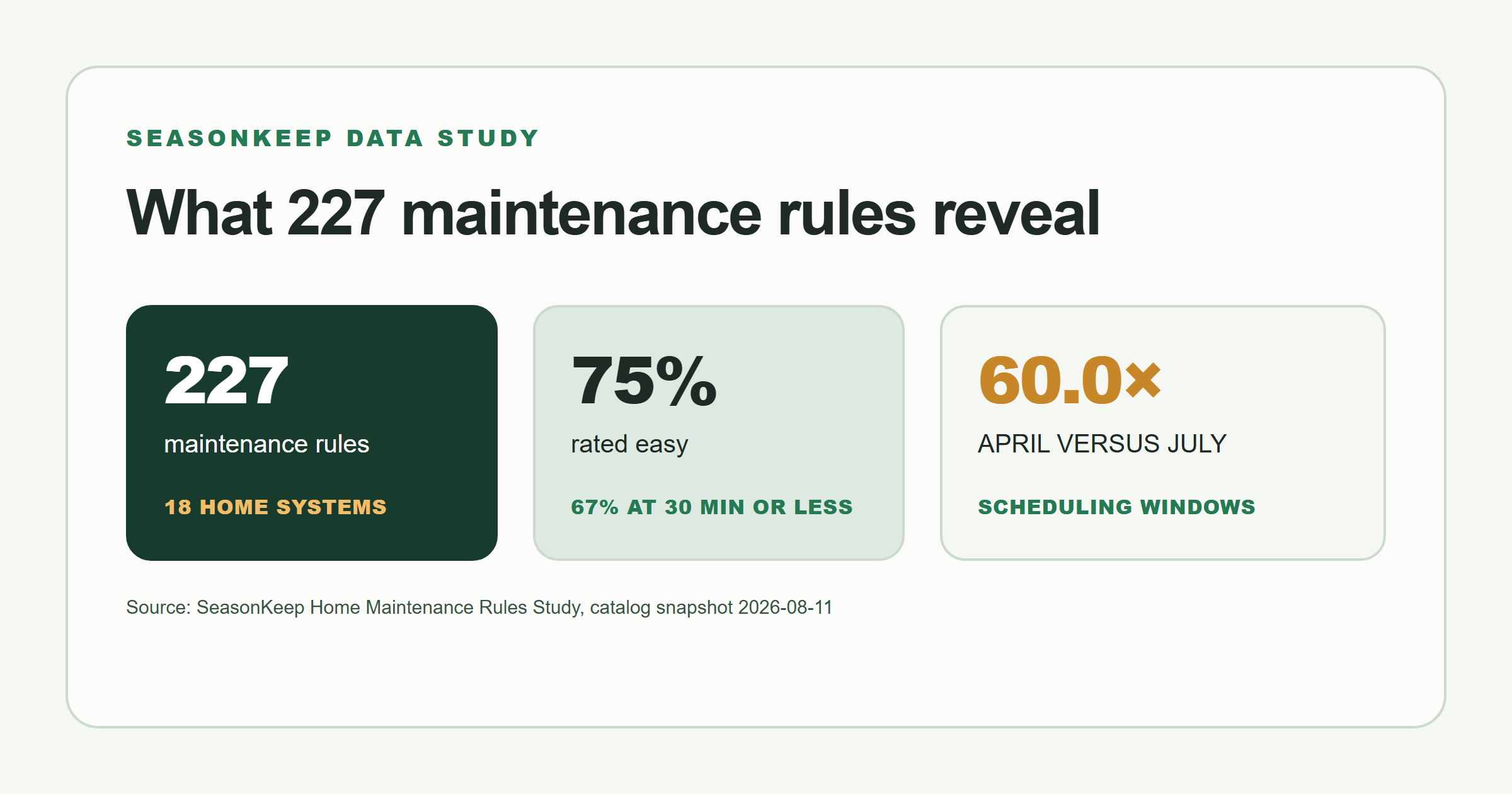
We analyzed the 227 maintenance rules that SeasonKeep uses to build schedules across 18 home systems. In the August 11, 2026 snapshot, 75% were rated easy, 67% had an active-work estimate of 30 minutes or less, and April appeared in 60 times as many effective seasonal windows as July.
This is an analysis of SeasonKeep's task catalog, not a survey of homeowners and not a record of completed work. One home will receive only the rules that match its systems, age, and climate. The figures describe how the full catalog is organized.
75% of the catalog is rated easy
The catalog's difficulty field breaks down this way:
- 170 rules (74.9%) are rated easy. Examples include inspecting accessible filters and completing visual checks.
- 26 rules (11.5%) are rated moderate. These tasks may require more time, tools, access, or judgment.
- 31 rules (13.7%) are professional-only. These are tasks where training, licensing, specialized equipment, or safety risk makes professional service the appropriate path.
"Easy" is a product classification, not a promise that every homeowner should do the work. The model-specific instructions, local code, access conditions, and the homeowner's ability still control the decision.
153 rules have 30 minutes or less of active work
For this analysis, we used the midpoint of the first active-work range in each rule's time estimate. We converted hours to minutes, ignored parenthetical wait or machine-cycle time, and treated a per-unit estimate as one unit.
On that basis, 153 of 227 rules (67.4%) have a midpoint of 30 minutes or less. This does not mean each visit consumes only 30 calendar minutes. Setup, travel, drying, cooling, repeated units, or a professional appointment can add time. It does show that remembering and grouping small tasks is a different problem from completing a few large projects.
April has the most effective seasonal-window assignments
The scheduling engine uses explicit seasonal months when a rule defines them; otherwise it uses the rule's optimal months. A rule is counted in every month of that effective window. The busiest months in the snapshot are:
- April: 120 assignments
- October: 90 assignments
- July: 2 assignments
- December: 7 assignments
April therefore has 60 times as many effective seasonal-window assignments as July. That is a comparison of scheduling windows, not hours of labor. A six-minute inspection and a multi-hour job each count as one assignment.
Across the catalog, 186 rules (81.9%) identify at least one preferred season or month. The pattern supports two practical habits: review the April home-maintenance checklist before spring work accumulates, and make a second plan before the October winterization window.
The 18 systems are not evenly represented
The six largest categories are:
- HVAC: 30 rules
- Plumbing: 23 rules
- Exterior: 23 rules
- Roof: 22 rules
- Landscaping: 21 rules
- Electrical: 16 rules
Specialty systems have fewer rules: pools have 7, generators have 5, hot tubs have 4, and fireplaces have 1. These are catalog counts, not a ranking of which system is most important or most expensive. They show why a schedule should remove systems a home does not have instead of handing every owner the same master list.
The 5.9x cost ratio needs context
Of the 227 rules, 13 contain both a DIY materials range and a professional-service range. Five of those have a DIY midpoint of $0, which makes a professional-to-DIY ratio undefined. We calculated the median ratio only across the remaining 8 rules with a positive DIY midpoint.
For that comparison set, the professional-price midpoint is 5.9 times the DIY-materials midpoint at the median. This is not a market-price survey and it does not prove that DIY is the better choice. The two estimates measure different things:
- DIY cost covers listed materials, not the homeowner's time, tools, risk, or rework.
- Professional cost can include labor, equipment, licensing, insurance, diagnosis, and local overhead.
- A professional-only rule is not a candidate for a DIY savings calculation.
Use the figure to understand the catalog's assumptions, then get local quotes for a real project. The annual home-maintenance cost guide explains how to plan for materials and professional service separately.
Priority is a triage field, not a guarantee
The catalog contains:
- 23 critical rules (10.1%)
- 77 high-priority rules (33.9%)
- 104 medium-priority rules (45.8%)
- 23 low-priority rules (10.1%)
These labels help sort a schedule. They do not replace a recall notice, local safety requirement, manufacturer instruction, or professional diagnosis. A condition discovered during a low-priority cosmetic check can still require immediate action.
Climate affects 19 rules
The snapshot contains 19 unique rules (8.4%) with a climate-specific frequency modifier or an excluded climate zone. In practice, that means the engine can change how often a task appears or omit it where the condition does not apply.
Climate is one filter among several. Installed systems, equipment type, home age, and task dependencies can also change the final schedule. The climate-zone maintenance guide explains the regional layer without suggesting that every home in one zone is identical.
How we calculated the results
- Snapshot: SeasonKeep's 227-rule maintenance catalog on August 11, 2026.
- Scope: Rule definitions, not customer homes, user behavior, or completed tasks.
- Difficulty and priority: Counts of the catalog fields at the snapshot date.
- Time: Midpoint of the first active-work range, normalized to minutes. Parenthetical wait time was excluded and per-unit work was counted as one unit.
- Month: Each rule counted once in every effective seasonal month. Explicit
seasonalMonthstakes precedence overoptimalMonths, matching the scheduling engine. - Seasonal: Unique rules with at least one seasonal or monthly scheduling value.
- Cost ratio: Median of professional midpoint divided by DIY midpoint for the 8 rules with both ranges and a positive DIY midpoint.
- Climate: Unique rules with a climate-zone frequency modifier or an excluded climate zone.
Review the citation-ready dataset, methods, limitations, and CSV download. The public data contains aggregate figures only. No customer data was part of the analysis. Read how SeasonKeep builds recommendations for the broader scheduling methodology.
Common questions
Does a typical home receive 227 tasks?
No. The 227 figure is the full catalog across 18 systems, including pools, solar, generators, and hot tubs. A home's schedule is filtered to the systems and conditions that apply.
Is every rule a once-a-year task?
No. Rules have different frequencies and can be adjusted or excluded by home and climate inputs. The monthly counts measure preferred scheduling windows, not annual task totals for one home.
Is DIY really about 6 times cheaper?
The 5.9 figure is the median ratio between two internal estimate midpoints for an 8-rule comparison set. It compares DIY materials with a professional service price, so it is not an apples-to-apples labor comparison and should not determine whether a job is safe to do yourself.
Why did the figures change from the July analysis?
The task catalog is maintained over time, and this revision also applies a more explicit time and cost methodology. The date, calculation rules, and downloadable aggregates make future comparisons visible instead of presenting the numbers as permanent facts.
Want to see the smaller list that matches your home? Build my free schedule from your home age, systems, and ZIP code.