Complete Home Maintenance Checklist by Season
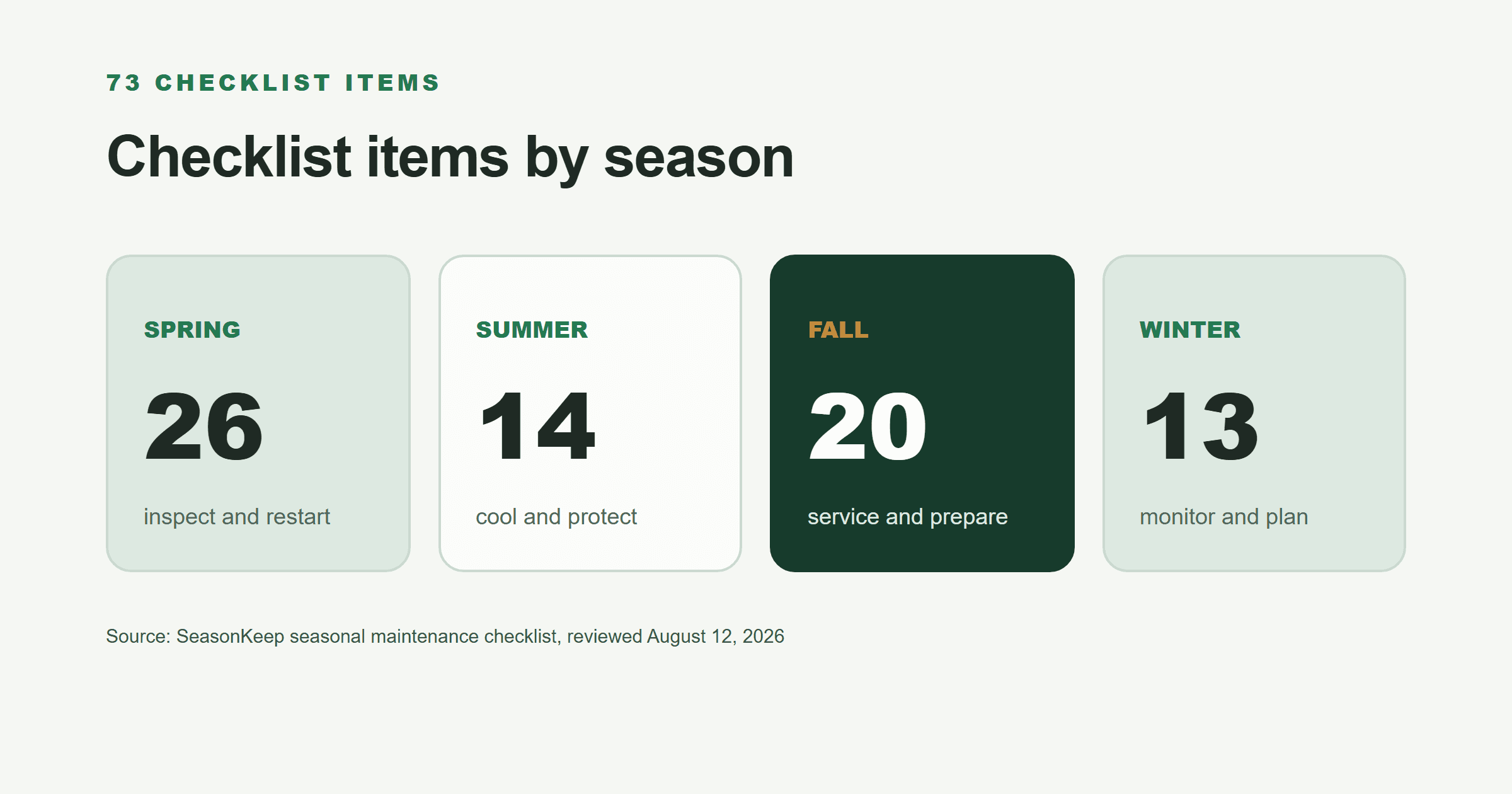
Seasonal weather creates useful planning windows, but it does not give every home the same checklist. Spring often brings drainage and exterior reviews; summer can suit selected outdoor work; fall is a good time to review installed heating and local freeze-protection needs; winter favors indoor monitoring and planning. The list below draws from the same 220+ rule catalog that powers SeasonKeep's personalized calendars, so apply only the items that fit your systems, condition, climate, and product instructions.
Print it, bookmark it, or let us turn it into a schedule tailored to your specific home. If you're deciding how much to budget, our preventive-maintenance planning guide explains how to use local quotes and keep a separate repair reserve without promising a universal payback.
Spring (March – May)
Spring has the most checklist items in this guide. That count reflects planning prompts, not hours of labor. Local weather can also make spring a useful window for drainage, exterior review, and applicable outdoor service.
HVAC
- Schedule cooling service if the home has cooling equipment. ENERGY STAR recommends a professional pre-season check. Our HVAC maintenance schedule covers the equipment-specific boundaries.
- Have the evaporator coil inspected. Internal cleaning belongs in qualified service unless the installed manual provides an owner procedure.
- Clear the outdoor unit. Remove loose leaves and debris without opening panels. Rinse only when the installed model permits it.
- Leave refrigerant work to an EPA-certified technician. A homeowner cannot diagnose charge from a visual check.
- Review your thermostat schedule. Switch from heating to cooling settings.
Plumbing
- Check water pressure. Record a safe gauge reading with household water use off. EPA WaterSense identifies 45 to 60 psi as an efficient range; ask a plumber to evaluate a persistent abnormal reading or one above 80 psi.
- Check the main water shutoff. Locate and label it. Operate it only when its condition and instructions permit, and never force a stiff or corroded valve.
- Inspect outdoor hose bibs. Pressurize them slowly after freezing weather and watch the outside fitting and accessible indoor piping before attaching hoses.
- Test sump pump operation. Use the installed manual's water or controller test without reaching into a powered pit.
- Check the water meter for hidden use. Stop expected water use, note the reading, wait 2 hours, and check again. Rule out scheduled appliances before treating movement as a leak.
Roof and Gutters
- Review gutters and downspouts from the ground. Look for overflow evidence, loose sections, blocked outlets, or discharge problems. Arrange qualified cleaning or repair when debris restricts flow or access requires a ladder or roof-edge work.
- Do a visual roof inspection from the ground. Look for missing, curled, or cracked shingles with binoculars.
- Review visible roof flashing from the ground. Use binoculars to document a visible change around chimneys, vents, or skylights. Leave roof access, diagnosis, and repair to a qualified roofer.
- Check downspout discharge. Confirm each outlet is connected and sends water to a stable location that drains away without causing erosion, ice, a backup, or a neighbor problem. The correct distance depends on grading, soil, local requirements, and the drainage design.
Exterior
- Inspect siding from the ground. Document loose, cracked, warped, stained, open, or soft-looking areas and arrange qualified review for elevated or uncertain damage.
- Check exterior sealant. Look for gaps, loss of adhesion, and staining. Identify the joint and drainage path before repair, and use the component and sealant instructions together.
- Inspect driveways and walks. Note cracks, settlement, heaving, loose material, ponding, and trip hazards. Diagnose continued movement or drainage before filling the surface.
- Review exterior cleaning needs. Identify each surface and finish, then use the gentlest manufacturer-approved method. Pressure washing is not appropriate for every material and can disturb old paint.
Safety and Pest Control
- Test smoke and CO alarms. Press the test button on every unit. The CPSC recommends monthly smoke and CO alarm tests; follow the manufacturer's battery and replacement instructions.
- Inspect fire extinguishers. Keep each unit accessible, check its pressure indicator, and inspect the pin, tamper seal, hose, and body. Follow the label for any model-specific maintenance such as shaking or professional service.
- Review whether a structural-pest inspection is due. Use prior reports, treatment or monitoring agreements, transaction or local requirements, prior infestations, and current evidence to decide whether to arrange qualified service.
- Review pest activity before treatment. Identify the pest and conditions first. If a pesticide is warranted, follow its label and prevent exposure, drift, and runoff.
Landscaping
- Review irrigation at spring startup. Follow the installed controller, valve, backflow, and winterization instructions. Run each zone to find leaks, damaged heads, runoff, overspray, and coverage gaps. Use a qualified irrigation professional when startup or repair is outside the owner instructions.
- Review whether aeration is needed. Confirm compaction, drainage, soil moisture, turf type, and timing with local extension guidance. Mark irrigation, roots, rocks, and shallow utilities before powered equipment.
- Review lawn nutrient and weed-control needs. Use a soil test, turf species, observed condition, local extension guidance, water-quality rules, and each product label rather than one national temperature trigger.
- Review mulch depth and placement. Measure what remains and add only what the plant, site, drainage, and local wildfire guidance support. Keep mulch off trunks, stems, siding, weep openings, vents, and equipment.
Summer (June – August)
Summer is lighter on maintenance. Focus on keeping systems running efficiently and addressing anything that surfaces during heavy use.
HVAC and Appliances
- Inspect the HVAC air filter. Check it monthly, then clean or replace it when dirty and as the filter or equipment instructions require.
- Review refrigerator condenser care. Find the model instructions before opening a panel or cleaning coils. Some refrigerators need routine owner cleaning; others use a different condenser design or require service access.
- Review the dryer lint and exhaust system. The U.S. Fire Administration recommends cleaning the lint filter every time you use the dryer and the exhaust duct yearly. Use the six-month reminder to check condition and whether that yearly work is due.
- Check dishwasher filters and spray arms by model. Some filters need manual cleaning, while others are self-cleaning. Follow the manual before removing parts, and confirm loaded dishes do not block spray-arm movement.
Exterior and Landscaping
- Inspect the deck before coating it. Look for loose boards, movement at guards or stairs, corrosion, decay, and finish condition. Stop using an unstable area and arrange a qualified structural inspection.
- Check the dryer vent exterior cap. Ensure the flap opens freely and isn't blocked by lint or debris.
- Review mower blade condition. Follow the exact mower manual to isolate power and inspect the blade from a stable position. Replace a cracked, bent, worn, or otherwise damaged blade; use authorized service when access, removal, balancing, torque, or power isolation is uncertain.
- Eliminate mosquito breeding sites. Empty standing water from saucers, gutters, and unused containers weekly.
Pool and Outdoor Systems
- Test pool disinfectant and pH at least twice a day while operating. Test more often during heavy use, follow the test-kit and chemical labels, and never mix different products. CDC recommends pH from 7.0 to 7.8 and at least 1 ppm free chlorine, or at least 2 ppm when cyanuric acid is used.
- Treat an operating hot tub as its own water system. CDC recommends testing at least twice a day, with pH from 7.0 to 7.8 and at least 3 ppm free chlorine. If the spa uses bromine or another approved system, follow its test kit, product labels, and owner's manual; never mix products or transfer pool instructions to the spa.
- Clean the hot-tub filter and test its GFCI by the installed instructions. A current Hot Spring manual uses a four-week filter-cleaning interval, while the exact removal and cleaner depend on the model. CPSC says to test permanently installed GFCIs monthly. Stop using the spa if a GFCI does not trip or reset, and use a qualified electrician.
- Clean pool skimmer and pump baskets at the installed manuals' intervals. Disconnect power and relieve system pressure exactly as directed before opening a pump or filter.
- Inspect the pool pump and filter. Check externally for leaks, loss of prime, unusual noise, abnormal pressure, and control faults. Stop and arrange qualified service for electrical faults or pressurized repairs.
- Review suspected lawn pests before treatment. Identify the pest and confirm that treatment is warranted. Follow local extension guidance and the pesticide label for timing, site restrictions, people and pet safety, and runoff protection.
Fall (September – November)
Fall is a useful window for local freeze preparation, drainage checks, and installed heating review. Not every home needs every task, and timing depends on weather, equipment, exposure, and local guidance. Our fall maintenance guide walks through the season in more depth.
HVAC
- Schedule heating service for the installed equipment. Fuel-burning furnaces and boilers need annual qualified inspection. Follow the manufacturer for heat pumps and other systems.
- Review thermostat modes, schedules, and alerts. Follow the model instructions for batteries, sensors, updates, and calibration.
- Leave blower, belt, bearing, motor, and internal electrical work to qualified service unless the installed manual identifies an owner procedure.
- Inspect visible fuel-appliance venting. From a safe position, look for loose sections, corrosion, damage, or soot. Do not touch or repair it.
- Check radiators for leaks, noise, or cold sections. Bleed only when the installed system's owner instructions provide the procedure.
Plumbing
- Review the water heater manual and inspect for leaks. Tank, heat-pump, and tankless models have different service intervals and procedures. Use the exact model manual or a qualified technician.
- Prepare outdoor faucets. Disconnect hoses, then follow the installed faucet and plumbing instructions for any dedicated shutoff and drain. Do not force an unknown valve.
- Check pipe insulation. Inspect accessible insulation in unheated areas and preserve clearance from flues, heat, and electrical equipment.
- Inspect washing machine hoses. Look for bulges, kinks, cuts, wear, corrosion, or moisture. Follow the installed washer and hose replacement interval.
- Review the water heater relief-valve instructions. The model manual and valve label control the procedure. Discharged water can scald, and a valve that will not reseal needs professional service.
Roof, Gutters, and Exterior
- Review gutter and downspout drainage after leaf fall. Observe flow from the ground and arrange qualified service when debris, guards, height, or access make cleaning unsafe. Restricted drainage can add water and ice at the eaves, but it is not the only ice-dam cause.
- Review accessible attic moisture and ventilation. From a safe access point, note staining, condensation, blocked openings, or changed insulation. Do not alter ventilation without understanding the roof and attic assembly.
- Review visible shingle and drainage changes. From the ground, note missing or damaged roofing and unusual granule accumulation. Age and granules alone do not diagnose remaining roof life; compare changes with manufacturer and qualified-roofer guidance.
- Schedule chimney inspection and service. Have a qualified chimney professional inspect the chimney and connected appliance before regular seasonal use. Cleaning and repair depend on the fuel, deposits, damage, appliance, and installed system.
- Review interior air-sealing boundaries. Check accessible attic doors, hatches, and other conditioned-to-unconditioned boundaries for a worn gasket, gap, failed latch, or damaged frame. Match replacement weatherstripping to the installed component. Do not treat a garage-to-house fire-separation gasket as an ordinary draft strip.
- Review attic insulation and moisture from a safe access point. Look for changed insulation, staining, moisture, blocked ventilation, exposed wiring, or unsafe material. Climate, assembly design, air sealing, and local requirements determine the target. Use qualified help before disturbing or adding material.
Landscaping and Pest Control
- Review and winterize the irrigation system. Follow the installed shutdown and drainage procedure before local freezing conditions. Use a qualified irrigation professional when compressed air is required or the procedure, valves, or backflow device are uncertain.
- Review trees near the house and access routes. Look from the ground for dead, broken, hanging, or rubbing branches and conflicts with structures, paths, sight lines, or utilities. Use qualified help for large, elevated, damaged, or uncertain work.
- Review fall lawn nutrient needs. Use the turf species, a current soil test, observed condition, local extension guidance, water-quality rules, and the product label. Do not assume every cool-season lawn needs a high-potassium product.
- Inspect possible pest entry points. Do not seal a vent, drainage opening, moving joint, or active infestation without identifying it. If work disturbs paint on a pre-1978 home, use EPA lead-safe practices.
Winter (December – February)
Winter maintenance is mostly indoor and monitoring-focused. The goal is catching problems early before spring.
HVAC and Safety
- Inspect the HVAC air filter. Check monthly and service it according to its actual condition and instructions.
- Check a heat pump for persistent ice. Brief frost and defrost can be normal. Contact a technician if ice remains or heating performance drops.
- Read the boiler gauge or sight glass. Compare it with the installed manual instead of a universal pressure target, and report leaks or sustained changes.
- Test CO alarms on each level and outside sleeping areas. Use the manufacturer placement instructions; do not move an alarm next to heating equipment unless those instructions call for it.
- Audit extension cord usage. Holiday lighting and space heaters overload circuits, so verify wattage ratings.
Plumbing and Interior
- Check drains and strainers. Clean accessible strainers, note slow flow or gurgling, and use only a cleaning method approved for the fixture, piping, disposal, and septic system.
- Review range-hood filters. Wash or replace a removable grease filter as the manual directs. Charcoal filters usually need replacement rather than washing, and the interval depends on the model and use.
- Check whether dryer-exhaust service is due. The U.S. Fire Administration recommends yearly duct cleaning. SeasonKeep uses a six-month condition check so damage or restricted airflow can be addressed sooner without assuming another full cleaning is needed.
- Review ice-dam evidence. Icicles or uneven roof-snow melt can justify a qualified building-envelope or roofing assessment, but they do not identify one repair by themselves. Air leakage, insulation, ventilation, roof geometry, and weather all need to be considered together.
- Review your home emergency kit. Replace expired batteries, medications, and food supplies.
Planning and Preparation
- Review mower off-season maintenance instructions. Use the exact walk-behind, riding, battery, corded, robotic, or combustion-model manual. Isolate power before service and apply only the steps that fit the installed equipment. Do not work beneath an unsupported mower or improvise a fuel, battery, blade, or safety-control procedure.
- Check the sump pump. Follow the installed pump or controller test, stay dry, and keep hands and tools out of a powered pit.
- Plan spring exterior work. Use winter inspection notes to request comparable scopes for deck, paint, masonry, siding, or roof work. Pre-1978 paint work needs an EPA Lead-Safe Certified contractor when the RRP Rule applies.
Turn This Checklist Into a Plan
This list covers the essentials, but every home is different. Your climate zone, home age, installed systems, and features all change which tasks matter and when they should happen.
SeasonKeep uses your home profile to select relevant rules and create dated reminders from their supported schedules. Some entries use a seasonal window; others ask you to check the installed manual, observed condition, local requirements, or a qualified provider. Cost ranges appear only where the underlying rule has a supportable range, and local quotes still control actual project costs.
Get a personalized version of this checklist for your specific home →