What Home Maintenance Costs in 2026: A Practical Budget Method
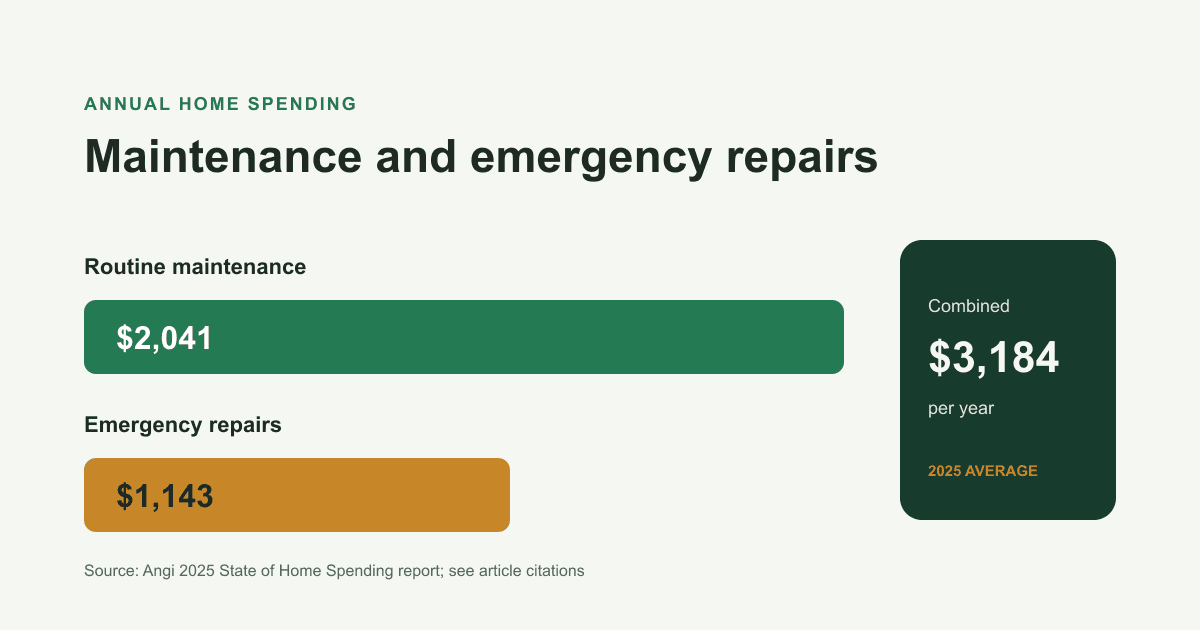
Angi's State of Home Spending report put average maintenance spending at $2,041 per household in 2025, up from $1,750 the year before, with another $1,143 going to emergency repairs. That national average is a benchmark, not a quote for one home. Build the budget from the systems you own, their instructions, current condition, local labor, safe owner work, and a separate repair reserve.
The free home maintenance log template provides PDF, XLSX, and CSV formats for recording completed work, provider details, and logged costs. Its workbook summary describes entered history only; it does not forecast future spending or savings.
How much should you budget for home maintenance?
The classic guidance is to set aside 1% to 4% of your home's value every year. Fannie Mae's homeowner guidance pegs it at that range: for a $350,000 house, that's $3,500 a year at the low end, which is plenty for a newer home, while homes past the 30-year mark should budget toward the top of the range.
Notice the gap between that savings target and the $2,041 people actually spend on routine upkeep. It isn't a contradiction. The 1% figure is a reserve, not a shopping list. In a normal year you'll spend well under it on tune-ups and filters; the surplus sits there for the year the water heater dies or the roof needs three squares of shingles. Budget the percentage, spend the task list.
HVAC: the biggest recurring line item
Heating and cooling costs depend on the equipment, local labor, access, and what the installed manuals require. Build this line of the budget from local quotes instead of a national package price.
- Filters: inspect accessible filters monthly. Clean or replace them when dirty and at the interval specified by the filter or equipment manufacturer.
- Pre-season service: get local quotes for the cooling and heating equipment the home actually has. A heating-only home does not need spring cooling service.
- Condensate drainage: look for standing water, leaks, overflow, or blockage. Use the installed model's cleaning procedure or include drainage in qualified service.
- Boilers and fuel-burning furnaces: keep the annual qualified inspection recommended by CDC and CPSC. The model defines the service scope.
- Duct cleaning: do not budget it on a three-year or five-year cycle. EPA recommends considering it only when conditions such as substantial visible mold, vermin, or excessive debris support it.
The full HVAC maintenance schedule separates owner checks from model-specific and professional work.
Water heater: inspect first, then price the model-specific work
- Manual and leak review: about 10 minutes and no materials. Record the model and serial number, find the manual, and check the unit, fittings, drain pan, and nearby floor for water or corrosion.
- Tank and heat-pump units: draining, relief-valve work, anode service, air-filter care, and condensate maintenance depend on the model. Use the manual to identify what is due.
- Tankless units: inlet-filter and descaling intervals depend on the model, installation, use, and water quality. The manufacturer also specifies the approved solution and restart steps.
- Fuel-burning units: CPSC recommends an annual professional inspection of the appliance, flue, and vent.
Get a local quote for the work the exact manual calls for. The water heater maintenance guide explains why a generic national flush price is not a reliable budget line.
Roof and gutters: price the access and material
- Gutter and downspout service: use spring and fall as default checkpoints, then adjust to observed drainage, trees, weather, guards, and wildfire exposure. Get a local quote tied to the roofline and access; roof-edge ladder work is not a zero-cost task just because the owner has a ladder.
- Professional roof inspection: price the material, roof size, slope, access, and requested scope. A walkaround, membrane assessment, tile-roof service, and leak diagnosis are not interchangeable products.
- Flashing and penetration review: inspect visible conditions from the ground. Do not budget a tube of generic sealant as the repair; compatibility and joint design determine the method.
- Ice-dam review: inspect accessible attic air leakage, insulation, ventilation, and prior problem areas. Heat cable is an electrical system, not a substitute for correcting heat loss.
Roof replacement is also site-specific. Keep installation records, warranty information, repairs, inspection photos, and local quotes together. Age can trigger planning, but condition and scope determine the decision and price. The sourced roof maintenance guide and gutter maintenance guide provide the details.
Plumbing, electrical, exterior, and appliances
Most tasks in these categories are free or nearly free, they just need to happen.
- Washing machine inlet hoses: inspect twice a year for bulges, kinks, cuts, wear, corrosion, or moisture. Replacement type, connection method, and interval come from the washer and hose instructions.
- Preparing outdoor faucets: remove, drain, and store hoses, then follow the installed faucet and plumbing procedure for any dedicated shutoff and drain. A cover is not a substitute for draining, and local equipment determines whether materials or professional help are needed.
- Septic service (if applicable): a typical system needs professional inspection at least every three years. Pumping depends on measured tank condition, household use, system design, and local requirements, so obtain a quote for the actual service scope.
- GFCI and AFCI tests: free, monthly, five to ten minutes. Follow the device instructions.
- Electrical-system review: use prior inspection findings, equipment labels, warning signs, renovation plans, and local requirements to define the electrician's scope and quote. Do not assume every home needs the same annual panel service.
- Smoke and CO alarm power: replace removable batteries when the exact model directs. Sealed and hardwired units use different power and replacement instructions.
- Exterior sealant: inspect the joint first. Material, access, failed flashing, movement, lead-safe controls, and whether the work is local or whole-house can change the scope enough that one national range is not useful.
- Wood-deck finish review: use the two-year reminder as a condition check. Price the exact cleaner, preparation, finish, access, and repair scope only after the deck is confirmed structurally sound.
- Chimney inspection and service: get a local written scope tied to the fuel, appliance, flue, deposits, access, and condition. Cleaning is not the same job for every chimney.
- Dryer exhaust review, every six months: check accessible condition and whether the yearly cleaning recommended by the U.S. Fire Administration is due. Get a local quote for a long, concealed, damaged, or unsafe-to-reach run.
- Refrigerator condenser care, every six months: read the model instructions first. Some coils are owner-cleanable, some need no routine cleaning, and others require service access. Price only the work the installed model calls for.
- Foundation and drainage review: the owner can document visible grading, runoff, moisture, movement signs, window wells, and accessible outlets. Price diagnosis and repair only after the site, foundation type, soil, drainage design, flood exposure, and changed conditions are understood. Structural assessment, broad regrading, drain service, waterproofing, and crack repair are different scopes, so one national range is not a useful quote.
Where you live moves every number
National ranges only get you so far, because professional labor is priced locally. A Zillow and Thumbtack analysis of essential upkeep costs found Los Angeles homeowners paying about $8,639 a year for a broad basket of hired maintenance services while Pittsburgh homeowners paid $3,373 for the comparable set. Same tasks, two and a half times the price. (Their basket includes services like house cleaning and lawn care, which is why it runs higher than the pure-maintenance figures above.)
Climate changes the task list itself, too. Coastal exposure can require more frequent outdoor-unit inspection or rinsing when the equipment manufacturer permits it. Cold-climate homes add winterization and ice-dam preparation. Heavy HVAC use makes the monthly filter inspection especially useful because the actual filter condition decides when service is due. Our seasonal maintenance checklist covers how the calendar shifts by region.
A realistic annual budget, two ways
Hiring out the core work: collect local quotes for the professional-only work your home needs, such as applicable HVAC service, gutter or roof work you cannot reach safely, chimney service, septic service, and model-specific water-heater work. Use the documented national spending figures above as a reserve reference, not a quote for that list.
Mostly DIY: use the actual filter, sealant, battery, finish, and cleaning-product needs to build a local materials budget. Add quotes for professional-only work such as applicable HVAC, chimney, septic, roof-access, and model-specific water-heater service.
Either way, keep routine spending separate from the repair reserve. Equipment, roof, and water-heater replacement costs depend on the home and local scope and should come from current quotes.
Common questions
Is the 1% rule still accurate in 2026?
As a savings target, yes. Actual routine spending usually comes in under 1% of home value; the rule works because the unspent balance covers the irregular big-ticket years. For homes over 30 years old, Fannie Mae suggests planning closer to 4%.
How much does doing it yourself actually save?
There is no reliable national percentage. Owner work may avoid a service call for simple, permitted tasks, but the comparison must include the exact materials, tools, time, access, risk, warranty terms, and the possibility of rework. Professional-only work is not a DIY savings opportunity.
Which tasks should you never skip, even on a tight budget?
Prioritize current safety instructions and conditions: clean the dryer lint filter as its instructions require, review accessible exhaust condition, keep drainage working, prepare installed outdoor plumbing for local freezing weather, and review the water heater manual and visible condition. The full dryer duct should be cleaned at least yearly under USFA guidance, with qualified service for gas connections, concealed or inaccessible runs, roof outlets, damage, or connections the owner cannot safely restore.
Why are the quotes I'm getting higher than these ranges?
The cited figures are broad national spending benchmarks or examples, not prices for each task. Local labor, service-call minimums, equipment, access, permits, material, and any newly diagnosed work determine the quote.
SeasonKeep builds this task list for your specific home, shows regional DIY and professional estimates where verified ranges are available, and reminds you before each task is due. Build your free schedule, no card required.