First-Time Homeowner Maintenance: The Year-One Guide
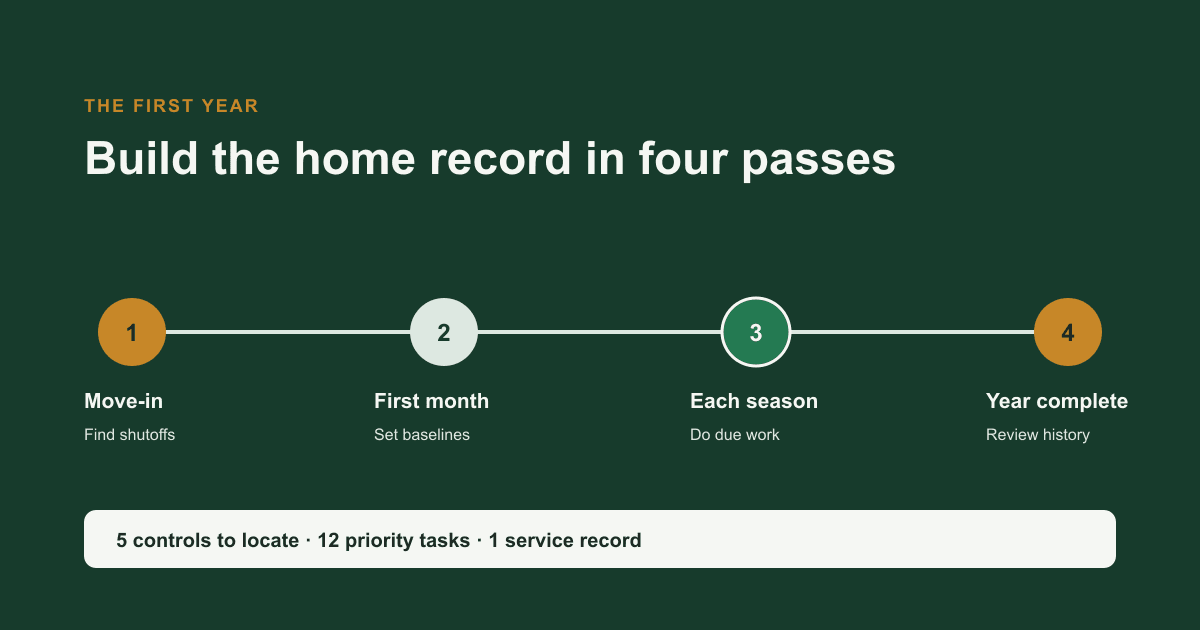
Year one starts with about a dozen recurring tasks, most of them under 30 minutes, plus qualified service for the heating and cooling equipment the home actually has. On day one, before the boxes are unpacked, locate your main water shutoff, breaker panel, HVAC filter information, water heater rating plate, and gas emergency instructions if the home uses gas. Local labor rates, equipment, and access determine the professional-service budget. The rest of this guide explains the schedule.
Nobody hands you a manual at closing. The inspection report tells you what's wrong today; it says nothing about what to do next October. This is that manual, trimmed to what a first-year homeowner genuinely needs.
Use the free home maintenance log template to keep completed dates, provider details, costs, and record locations together while you build the schedule. It is available as a printable PDF, an XLSX workbook, and a CSV with provenance notes followed by a clean eight-column header.
Five things to find on day one
Do this walkthrough before boxes and furniture hide the equipment and access points.
- The main water shutoff valve. It may be where the water line enters the house, in a basement, crawl space, utility area, or near the meter. Locate and label it. Inspect it before operating it, and never force a stiff, corroded, leaking, undocumented, or utility-owned valve. Ask the utility or a qualified plumber how the home's valve should be tested before an emergency.
- The breaker panel. Find it, open it, and check whether the circuits are labeled. If they're not, spend an evening with a helper flipping breakers and mapping outlets. Label everything.
- Your HVAC filter location and size. Pull the filter as the equipment instructions direct and read the dimensions, airflow arrow, and rating printed on the frame. Save those details with the model number. Inspection is monthly, but cleaning or replacement depends on the filter's condition and instructions.
- The water heater's model, age, and warranty. Photograph the rating plate and use the manufacturer's serial-number or warranty lookup because brands encode dates differently. Check the tank, fittings, drain pan, and nearby floor for water or corrosion. Age helps with planning, but it is not an automatic replacement date. Follow the exact model manual for temperature and maintenance settings.
- The gas emergency instructions, if you have gas. The utility should identify its equipment, owner responsibilities, leak warning signs, and emergency response. Do not assume every shutoff is at the meter or owner-operated. If you suspect a leak, do not search for it or operate switches, valves, phones, vehicles, or flames nearby. Leave by foot, keep others away, then call 911 and the gas utility from a safe location.
While you're walking around, press the test button on every smoke and carbon monoxide alarm. Follow the model's instructions if an alarm does not respond. Replace a removable battery when directed; replace the alarm or call a qualified professional if it has a sealed battery, is hardwired, or still does not respond.
If the home has a garage, photograph the door and opener labels so you can find both manuals. The federal opener standard calls for a monthly contact-reversal test, but the model instructions control the test and external safety sensors. Keep clear of springs, cables, and bottom brackets. For an attached garage, confirm the door into the house closes and latches and that the surrounding wall and ceiling have no visible damage or openings. USFA recommends a 20-minute fire-rated, self-closing, self-latching door; local code and the installed assembly determine what your home requires. Do not run a vehicle in an attached garage, even with the overhead door open.
Before boxes hide the lowest level, take dated photos of accessible foundation walls, basement or crawl-space conditions, window wells, grading, downspout outlets, and any retaining wall. Record existing cracks, stains, efflorescence, gaps, and drainage paths without diagnosing them. Do not enter standing water or an unsafe crawl space. If a condition changes later, the move-in record gives a structural, drainage, pest, or building-envelope professional something useful to compare.
Make a similar interior record. Photograph existing ceiling or wall stains, bathroom sealant and tile joints, toilet bases, wood-floor movement, carpet damage, and each handrail, guard, and installed grab bar. Run bathroom exhaust fans and note whether documentation or an accessible outlet confirms that they discharge outdoors. Do not press on tile, deliberately rock a toilet, apply body weight to a railing, or open a ceiling to investigate. Active water, movement, loose material, a damaged support, persistent odor, or recurring moisture deserves qualified evaluation.
The 12 tasks that matter most in year one
There are hundreds of possible maintenance tasks. These twelve are a practical first-year starting point.
- Inspect the HVAC filter: check it monthly, then clean or replace it when dirty and at the interval in the filter or equipment instructions. ENERGY STAR recommends monthly inspection.
- Test smoke and CO alarms: monthly, free, 5–10 minutes. The U.S. Consumer Product Safety Commission recommends monthly tests and following the manufacturer's battery and replacement instructions.
- Test GFCI outlets: monthly, free, 5–10 minutes. Follow the device instructions, confirm TEST cuts power, and confirm RESET restores it. Have a qualified electrician replace a device that fails.
- Cooling-system service, if applicable: arrange qualified pre-season service for central AC or a heat pump according to the equipment instructions.
- Fuel-burning heating service, if applicable: arrange annual qualified service for a gas or propane furnace. The full equipment-specific rhythm is in our HVAC maintenance schedule.
- Check gutter drainage: use spring and fall as default checkpoints, then adjust to the home's trees, weather, and observed overflow. Watch from the ground during safe rainfall and hire qualified gutter or roofing service for roof-edge access. Keep ladders and tools away from overhead conductors.
- Review the water heater maintenance schedule: spend about 10 minutes finding the exact model manual and inspecting for leaks or corrosion. Tank, heat-pump, and tankless service procedures and intervals differ, so use the manual or a qualified technician for the work itself.
- Prepare outdoor faucets: before freezing weather, remove and drain hoses, then follow the installed plumbing procedure for any dedicated shutoff and drain. A cover is not a substitute for draining.
- Inspect washing machine hoses: every 6 months. Look for bulges, kinks, cuts, wear, corrosion, or moisture, and follow the washer manual for replacement.
- Inspect the AC condensate drain and pan: look for standing water, leaks, overflow, or blockage. Use only the cleaning method in the installed equipment manual.
- Review water shutoffs: annually. Keep the main location clear and label accessible fixture valves. Look for corrosion, damage, or leakage without forcing or exercising an unknown valve. Ask a plumber or utility to identify uncertain equipment and confirm the safe test procedure.
- Eyeball the roof from the ground: every 6 months and after big storms, 15–20 minutes with binoculars. You're looking for lifted shingles, sagging gutters, and damaged flashing, so a cheap shingle fix doesn't become a ceiling stain.
Your first-year rhythm, month by month
This calendar assumes a January start; rotate it to whenever you actually moved in. Two things repeat regardless of month: test the detectors, and check whether the filter is due.
- January: Detector test. If you have a sump pump, use the installed manual's water or controller test without reaching into a powered pit.
- February: Test GFCI outlets and any arc-fault breakers at the panel.
- March: If the home has central AC or a heat pump, book qualified cooling service before regular summer use.
- April: Clean the gutters, inspect condensate drainage, and check outdoor faucets for freeze damage from the winter before you owned the problem.
- May: Clear loose debris and plants from the outdoor HVAC unit. Rinse it only when the installed model's instructions permit it.
- June: Check washer inlet hoses. For municipal water, stop all expected water use for two hours and compare meter readings. Movement means water flowed; first rule out scheduled appliances, irrigation, ice makers, and treatment devices before tracing a leak.
- July: Monthly GFCI test and a filter check; summer is otherwise light.
- August: Ground-level roof and yard walk with binoculars.
- September: Book the heating tune-up and review the water heater's model-specific maintenance schedule. The fall guide has the full pre-winter sequence.
- October: Gutters after leaf drop, alarm power and replacement dates, and a condition check of the main water shutoff. Operate the valve only when safe.
- November: Remove and drain outdoor hoses before freezing weather, then follow the installed faucet and plumbing procedure.
- December: Reset the thermostat schedule, wipe the vents, and tally what you spent and what surprised you. That list is next year's plan.
Keep the move-in foundation photos with this calendar. Recheck visible conditions in spring and fall and after a flood, earthquake, slope movement, nearby excavation, or major water event. A changing crack, leaning or bulging wall, new sticking openings, or newly uneven floor needs qualified evaluation; a crack pattern alone is not a diagnosis.
What does home maintenance cost in year one?
Filters, alarm batteries, faucet covers, and professional tune-ups vary by model and local labor rates. Sealed long-life alarms do not have replaceable batteries; alarms with removable batteries should follow the manufacturer schedule. Build the first-year budget from your actual equipment labels and local quotes rather than assuming every home needs two battery swaps. Budget model-specific water heater service separately after checking the manual and getting a local quote.
Separate from that, keep a repair reserve sized to the home's systems and your local costs. Maintenance cannot eliminate failures or promise a payback, but condition records and routine checks can make some problems visible before the repair scope grows. Our preventive-maintenance planning guide explains how to use local quotes without relying on a national savings claim.
Common questions
What's the most important maintenance task for a new homeowner?
Monthly HVAC filter inspection is one of the simplest high-value checks because the filter condition tells you when cleaning or replacement is due. Smoke and CO alarm tests are the most important for safety.
Should I do the inspection report items first?
Yes, triage those before starting the recurring calendar. Anything involving water intrusion, electrical hazards, or gas gets handled first; cosmetic items can wait indefinitely.
What if I move in right before winter?
Compress the fall list: remove and drain outdoor hoses, follow the installed faucet and plumbing procedure, schedule applicable heating service, check the gutters, and confirm the detectors work. Everything else can wait for spring.
Do I need a pro, or can I do this myself?
Most of year one is straightforward owner work: accessible filter inspection, alarm tests, visible valve checks, and removing and draining outdoor hoses. Hire qualified help for applicable HVAC service, anything on a ladder you cannot do safely, and anything involving fuel, combustion, refrigerant, internal electrical parts, unknown valves, or pressurized equipment.
Every home's version of this list is a little different: a heat pump changes the HVAC tasks, a septic tank adds a few items, and a Minnesota winter is not a Phoenix one. SeasonKeep builds the year-one calendar for your specific home from your zip code, home age, and systems, then emails you before each task is due. Build your free schedule and the free plan doesn't ask for a card.